
A Proton survey covered by TechRadar (24 September 2026) found that 66% of UK AI users have discussed at least one sensitive topic with a chatbot — money, work stress, mental health, relationships — while trust in AI companies stays low.
Privacy is not a GDPR footer tick. Here’s which assistants actually protect your data, which need careful settings, and what to think about before pasting client work into a chat.
Why private AI matters for UK users in 2026
Your prompt usually hits a provider’s servers. Depending on product and settings, it may be retained, human-reviewed, used for training, or reachable via lawful requests in that company’s jurisdiction.
Privacy ≠ GDPR. UK GDPR is about how you handle other people’s data. A vendor can claim compliant processing and still review chats for safety, train models (if allowed), or raise profiling worries — TechRadar cited 64% of UK respondents concerned about ad/marketing profiles. Journalists handling sources: see our AI tools for journalists 2026 guide.
Quick verdict by use case
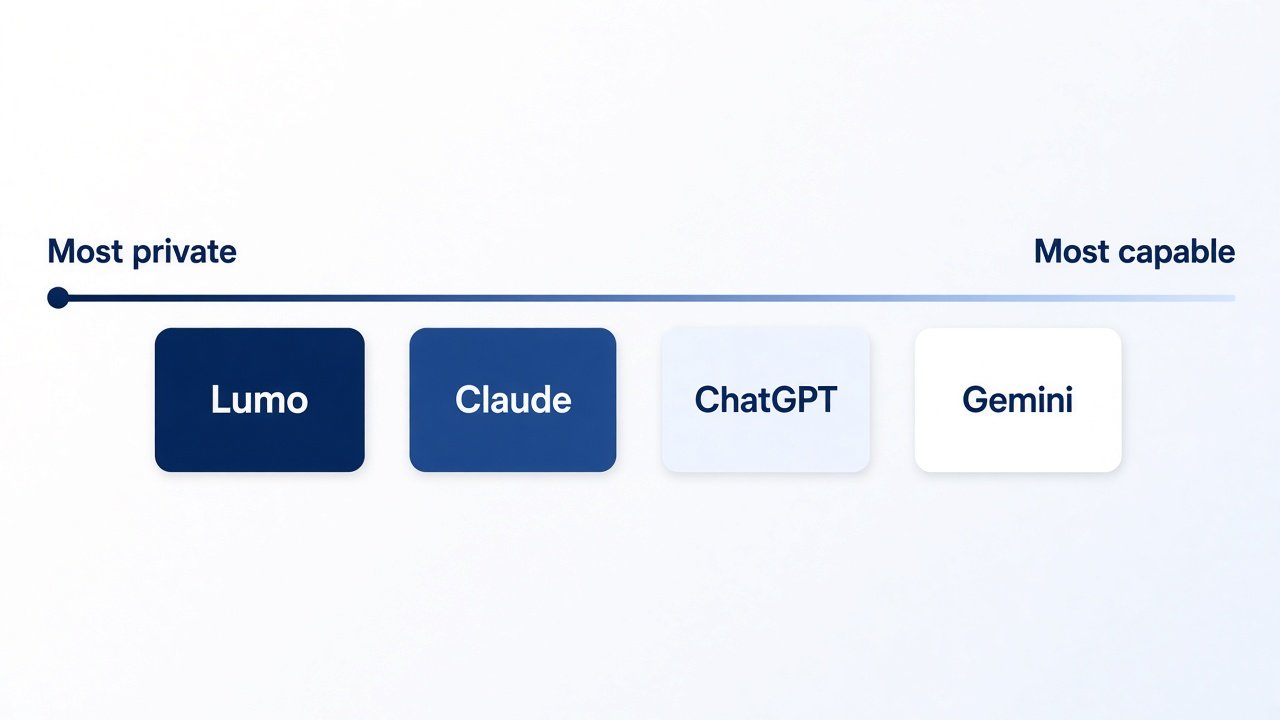
- Most private personal / sensitive chats: Lumo by Proton — zero-access encrypted history, no-logs design, chats not used for training (with a narrow feedback exception you choose).
- Best capability with strong consumer controls: Claude on a paid plan — disable model improvement if it’s on; use Incognito for sensitive threads. See also our Claude Pro review for UK users.
- UK workplace / Microsoft shops: Microsoft 365 Copilot with enterprise data protection — prompts and Graph data are not used to train foundation models under Microsoft’s commercial commitments.
- ChatGPT or Gemini “locked down”: usable for lower-risk work if you disable training / Keep Activity (or use temporary chats) — defaults are not privacy-first on personal accounts.
- Avoid for sensitive use: DeepSeek and similar China-hosted consumer apps — different legal regime and weaker privacy guarantees for UK users with confidential material.
(Claude usage tiers are covered separately in our Claude Max 20x UK price guide — this piece is privacy, not quotas.)
Comparison table
| Tool | Privacy model (short) | Jurisdiction / HQ | Trains on your chats? | UK-work fit | Rough consumer price |
|---|---|---|---|---|---|
| Lumo (Proton) | Zero-access encrypted history; no-logs; models on Proton-controlled servers | Switzerland / Europe (Proton AG) | No (optional anonymised feedback only for a specific model) | Best for sensitive personal or confidential brainstorming; less “frontier” than Claude/GPT | Free; Plus paid (check current Proton pricing) |
| Claude | Strong consumer privacy centre; Incognito; commercial terms for Team/Enterprise | US firm; Anthropic Ireland as controller for UK/EEA consumers | Consumer: turn off model improvement (often on until you disable); safety/feedback paths may still apply. Commercial: not by default | Strong for writing, research and analysis once settings are tightened | Free; Pro ~$20/mo (~£15–£16 before tax) |
| ChatGPT | Data Controls + Temporary Chat; Business/Enterprise stronger | US (OpenAI) | Personal Free/Plus/Pro: on by default until you opt out. Business/Enterprise/API: not by default | Fine for non-sensitive work after opt-out; use Business/Enterprise for client data | Free; Plus ~£16–£20/mo class |
| Gemini | Keep Activity + human review of some chats; Workspace differs | US / Google Ireland for EEA & Switzerland apps terms | Personal: Keep Activity on → used to improve Google AI. Turn off / use temporary chats to limit | Convenient with Drive/Gmail research workflows — lock settings first (Gemini research guide) | Free; Google AI / Advanced ~£16/mo class |
| Microsoft 365 Copilot | Enterprise data protection; processor commitments under Microsoft DPA | US / EU Data Boundary options for many EU workloads | Org prompts/responses/Graph data not used to train foundation models (per Microsoft docs) | Best default for UK firms already on Microsoft 365 | Add-on / included with eligible M365 plans (check Microsoft pricing) |
| DeepSeek (consumer) | China-hosted consumer service | China | Treat as unsuitable for confidential UK client or personal data | Avoid for sensitive work | Often free / low cost — privacy is the cost |
Prices move with FX, tax and App Store mark-ups. Always confirm on the vendor site before you buy.
UK work and GDPR — can you put client data in AI?
This is not legal advice — ask your solicitor or DPO if you process client personal data. Practical points for freelancers and small UK firms:
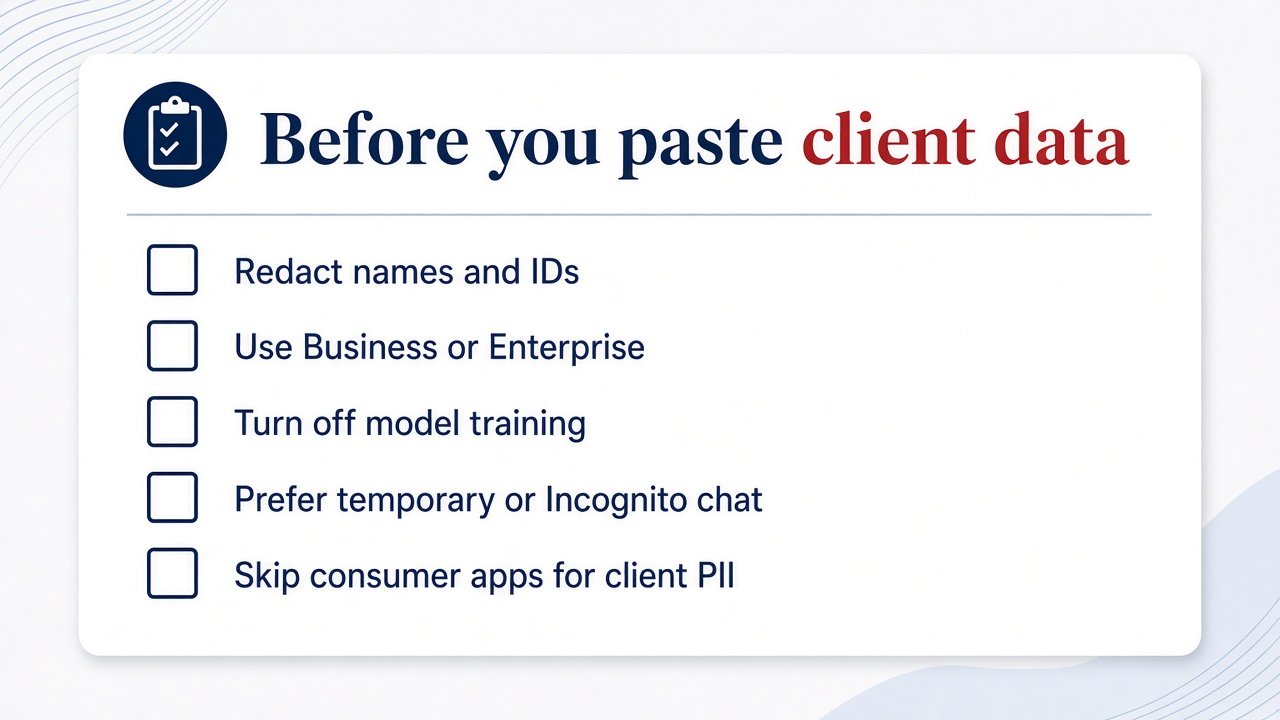
- Personal vs work: Consumer ChatGPT, Claude Free/Pro/Max and personal Gemini are for individuals. Client personal data usually needs Business / Team / Enterprise / Workspace with a DPA — not a personal Plus plan.
- Training defaults: Turn off “improve the model” / similar toggles. Use temporary or Incognito modes for sensitive one-offs.
- Residency ≠ never reviewed: Storage location is not the same as “nobody reads it.” Check subprocessors and safety review.
- Claude: UK/EEA consumer controller is Anthropic Ireland — not UK-only hosting. Commercial Claude/API have different training rules.
- DPIA / contracts: Special-category or high-risk client data may need a DPIA and contracts before any AI tool is involved.
- Minimise: Redact names and IDs. If you wouldn’t email it to a stranger, don’t paste it into a consumer chatbot.
Practical toolkit, settings checklist and FAQs
A sensible UK private-AI toolkit in 2026:
- Lumo for sensitive personal or confidential brainstorming
- Claude (settings tightened) for complex writing and document work — plus our Claude research guide
- Microsoft 365 Copilot if your firm already lives in Outlook/Teams/SharePoint
- NordVPN for the network layer on public Wi‑Fi (honest existing pattern — encrypts the connection; it does not make a US consumer AI into a Swiss vault)
Settings checklist (do this today):
- Claude → Privacy / data controls → disable model improvement; use Incognito for sensitive threads
- ChatGPT → Settings → Data Controls → turn off “Improve the model for everyone”; use Temporary Chat when needed
- Gemini → Gemini Apps activity → turn Keep Activity off (or use temporary chats); don’t paste secrets if human review is possible
- Work tools → confirm you’re on a Business/Enterprise tenant with a signed DPA
- Never use DeepSeek (or similar) for client, medical, legal or HR content
FAQs
Is the best private AI also the smartest?
Usually no. Lumo leads on privacy; Claude and ChatGPT still win many hard tasks. Pick by risk.
Does Pro/Plus equal private?
No. You still need the right settings — and for client data, a Business/Enterprise tier.
More research guides: Perplexity, ChatGPT, Grok — keep sensitive material out of those sessions.
Bottom line
UK users are already telling chatbots their secrets. The best private AI tool is the one whose architecture and contract match the risk of what you’re pasting.
- Maximum privacy: Lumo
- Maximum capability with careful consumer settings: Claude
- UK office default: Microsoft 365 Copilot
- Consumer ChatGPT/Gemini: only after you lock training/activity settings — and not for regulated client data
- DeepSeek for sensitive work: no
Re-check vendor privacy pages before you change how you handle client information — policies and defaults change.
Recommended Products on Amazon
- Noise Cancelling Headphones — for private conversations and focused work sessions
- Co-Intelligence by Ethan Mollick — understand how AI tools work and make informed decisions about which ones to trust
- Kindle Paperwhite — read about AI privacy and security without the tracking of online reading
This article contains affiliate links. If you purchase through our links we may earn a small commission at no extra cost to you. This helps us keep this website free and updated.